


Ownership record
Identify the submitting organization, artist or license source; attach the dated editable file; and name who can approve changes. If a supplied asset has restrictions, keep those terms with the order packet.
A crown-and-initial program joins a fixed symbol to characters with very different widths and internal spaces. Build the crown, glyph rules and placement system as original controlled artwork, then issue a readable proof for each approved variable.
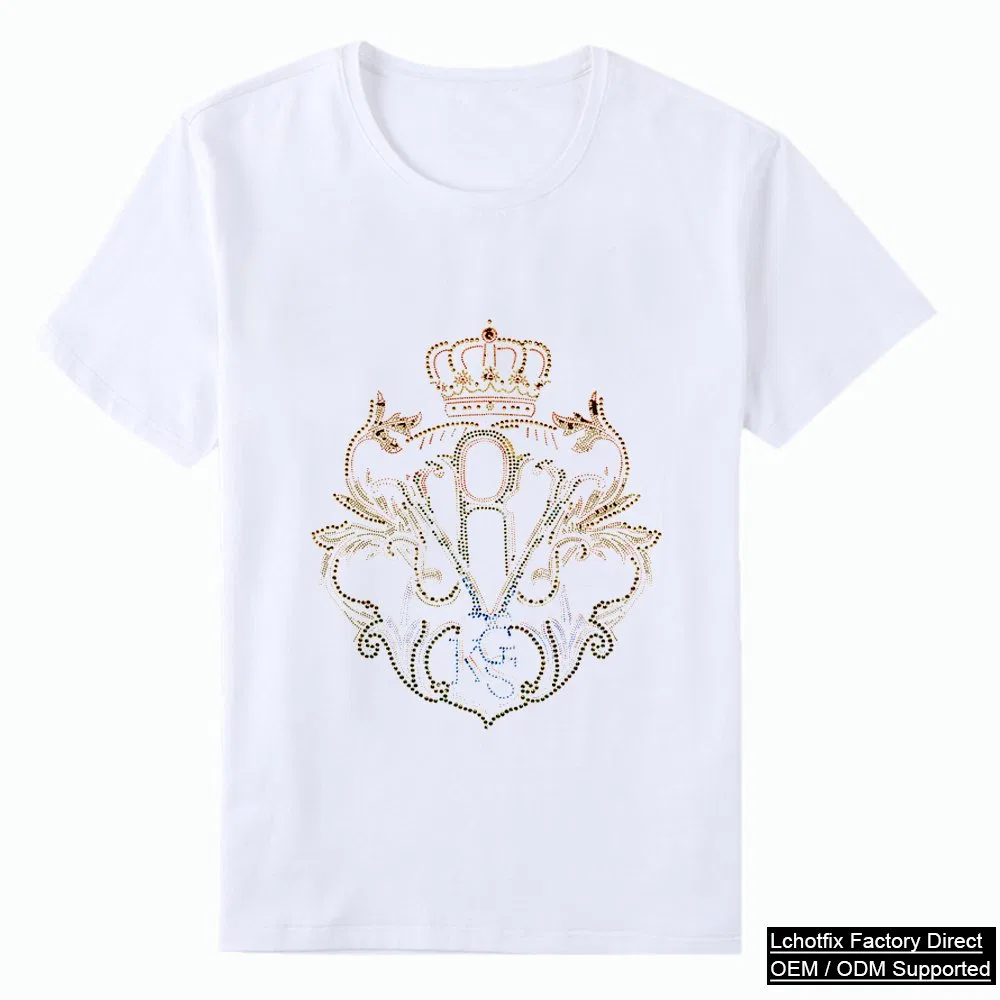
A generic idea can still become distinctive artwork. Draw the crown proportions, points, arches, jewels and baseline specifically for the program, and document the typeface or custom glyph source. Do not treat a marketplace screenshot, sports emblem or fashion mark as production authorization.
Identify the submitting organization, artist or license source; attach the dated editable file; and name who can approve changes. If a supplied asset has restrictions, keep those terms with the order packet.
Describe which crown geometry and letterforms were created for this project. Preserve sketches or source layers so later initials follow the same system without copying unrelated brand imagery.
A custom hotfix T-shirt design brief should also state the requested product form: loose transfer, patch or completed garment. Rights approval does not decide construction.
Product 169 names the transfer-patch direction and carries code RJX-502. Products 175 and 176 are finished 100% cotton T-shirt references with a 50-piece minimum. Product 175 is Minimal Crown Cat Rhinestone Heat Transfer T-Shirt, code EVA-LAS-042; Product 176 is Princess Crown Rhinestone Heat Transfer T-Shirt, code EVA-LAS-058.
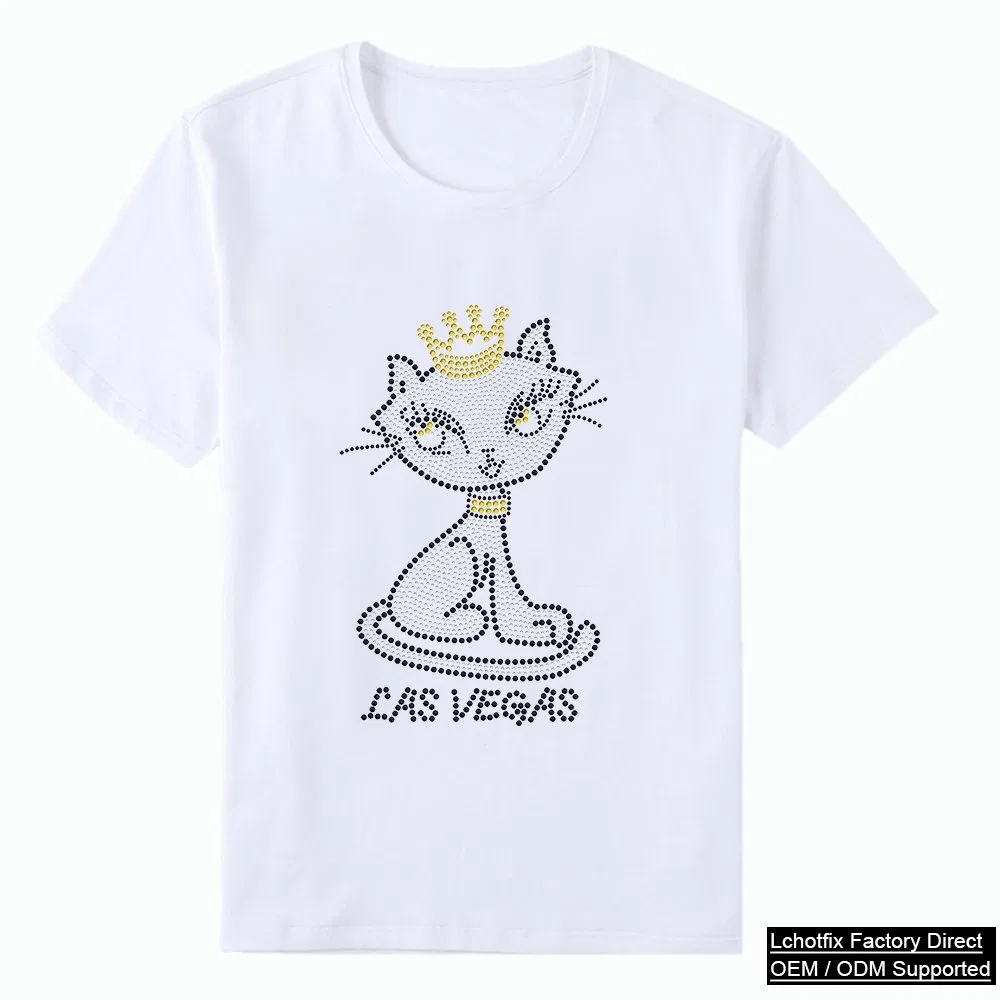
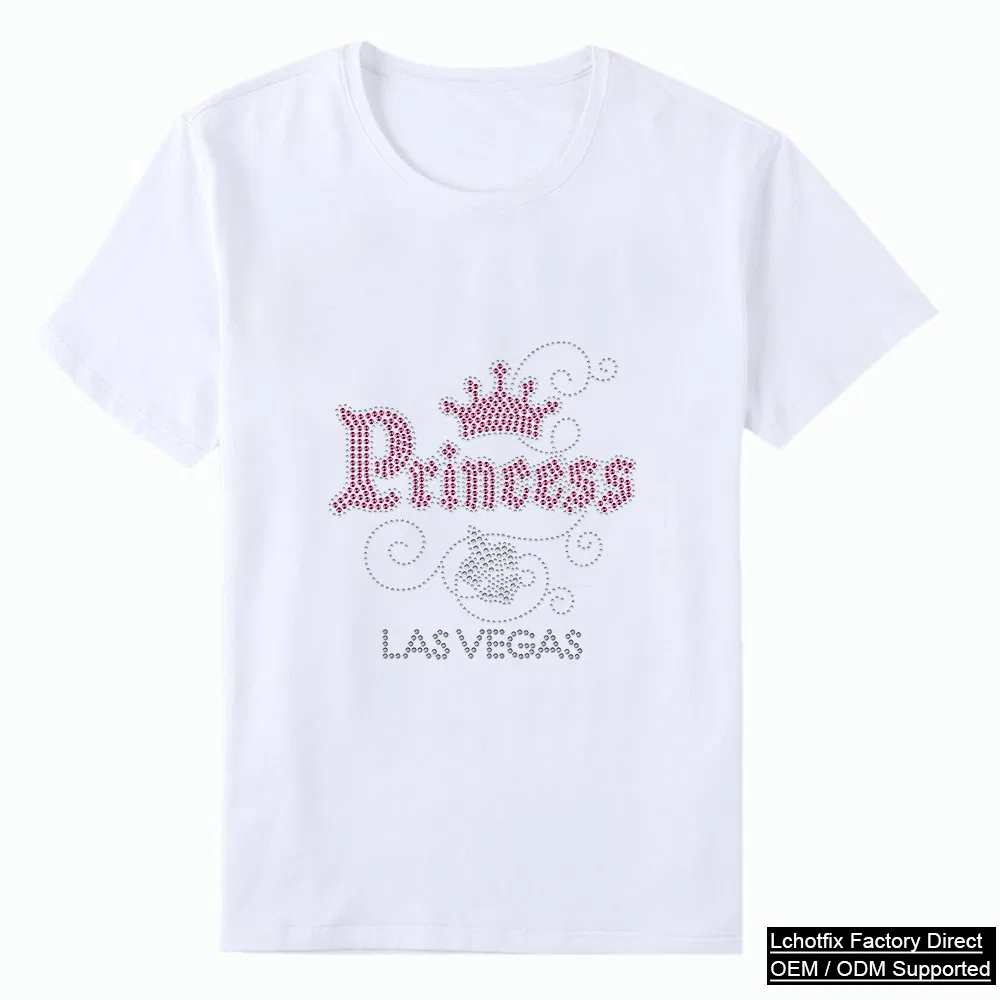
Use the Product 169 transfer reference, Product 175 shirt and Product 176 shirt only for their recorded contexts.
Start with representative narrow, round, diagonal and wide characters. Give each tile the same cap-height rule while allowing measured side bearings and optical correction. Inspect interior counters and diagonal joints at the final stone size, not only as vector outlines.
An alphabet crystal patch is a separate product construction from a crown transfer, but its character-width problems can inform the proof checklist. See the alphabet crystal patch guide for patch-specific bases and attachment questions.
Lock spelling, capitalization and allowed symbols in the variable register. Do not let a production operator improvise punctuation or substitute a font after the crown has been balanced.
Mathematical centering can make a narrow I look displaced under a broad crown and a wide W feel crowded. Define a crown axis, glyph axis and acceptable optical offset method. Test extreme characters first, then use the agreed rule for the remaining set.
Decide whether the crown remains fixed, narrows or uses side ornaments to control excess space. Preserve minimum negative openings around the character.
Check crown width, outer points and stone clearance against the widest approved letter. Never squeeze a glyph without an explicit redesign.
For personalized rhinestone iron on transfers wholesale, identify each optical exception in the variable proof rather than hiding it behind one master thumbnail.
Product 169 records an 8 × 10-inch design area even though its generic size field is blank. Treat that catalog footprint as a reference rather than deriving internal crown or glyph measurements from the photograph; a new program still needs its own complete measurement set and garment-placement diagram.
State complete width and height, plus orientation and the reference origin used by the proof.
Dimension crown height, glyph cap height, vertical gap and any lower ornament or baseline.
Name blank, size group, centerline and distances from stable garment landmarks.
Approve representative placement on the smallest and largest included garments. If multiple field sizes are needed, issue independent proof codes and quantities. The personalized transfer workflow covers variable naming and order reconciliation in greater detail.
A bling transfers wholesale order with variable initials needs a reconciliation record. Use one row per production version and prohibit informal spelling changes after sign-off.
Reconcile the sum of line quantities against the purchase order, carton plan and any replacement allowance. Retain rejected proofs rather than overwriting them, so the selected revision remains unambiguous.
The custom rhinestone transfer page provides broader construction questions outside this monogram-specific system.
The FAQ distinguishes artwork authorization, visual centering, dimensions and product form before a variable order is released.
Product 169 is Crown Monogram Rhinestone Heat Transfer Patch for T-Shirts. The database lists rhinestones, MOQ 50, item code RJX-502 and an 8 by 10 inch design area; its generic size field remains blank.
The requester should supply artwork it is authorized to reproduce. Use an original crown construction or documented licensed asset, and keep the rights record with the approved revision.
Not necessarily. Narrow and wide characters can appear unbalanced at identical mathematical coordinates. Establish optical placement rules, then approve representative extremes and every production proof required by the order.
State the complete finished width and height, crown height, character cap height, gap between elements and garment placement. A scaled proof should show those dimensions together.
No. Finished-shirt references show composition and placement context. The quotation must identify whether the request is for a transfer, patch or decorated shirt and confirm its current specification.
Send authorized crown and glyph source files, complete dimensions, stone color direction, garment placement, variable register, quantities, destination and requested timing. Identify whether Teebling is being asked to quote loose transfers, patches or finished shirts. Cite RJX-502 only when Product 169 is the intended reference.
Request written confirmation of construction, proof scope, sample route, current terms and packaging. The approved packet should carry the crown geometry, character rules, optical exceptions and the exact line-level proof revisions that the order must reproduce.