


Print plate
List flat colors, gradients, halftone decisions, underbase assumptions and any line that must remain continuous. Supply the original editable artwork rather than a compressed screenshot.
Build bling heat transfers as two coordinated visual systems. Print carries continuous color and fine illustration; stones create selected points of light. The useful decision is not which method wins, but which layer gives each detail a readable job on the finished garment.
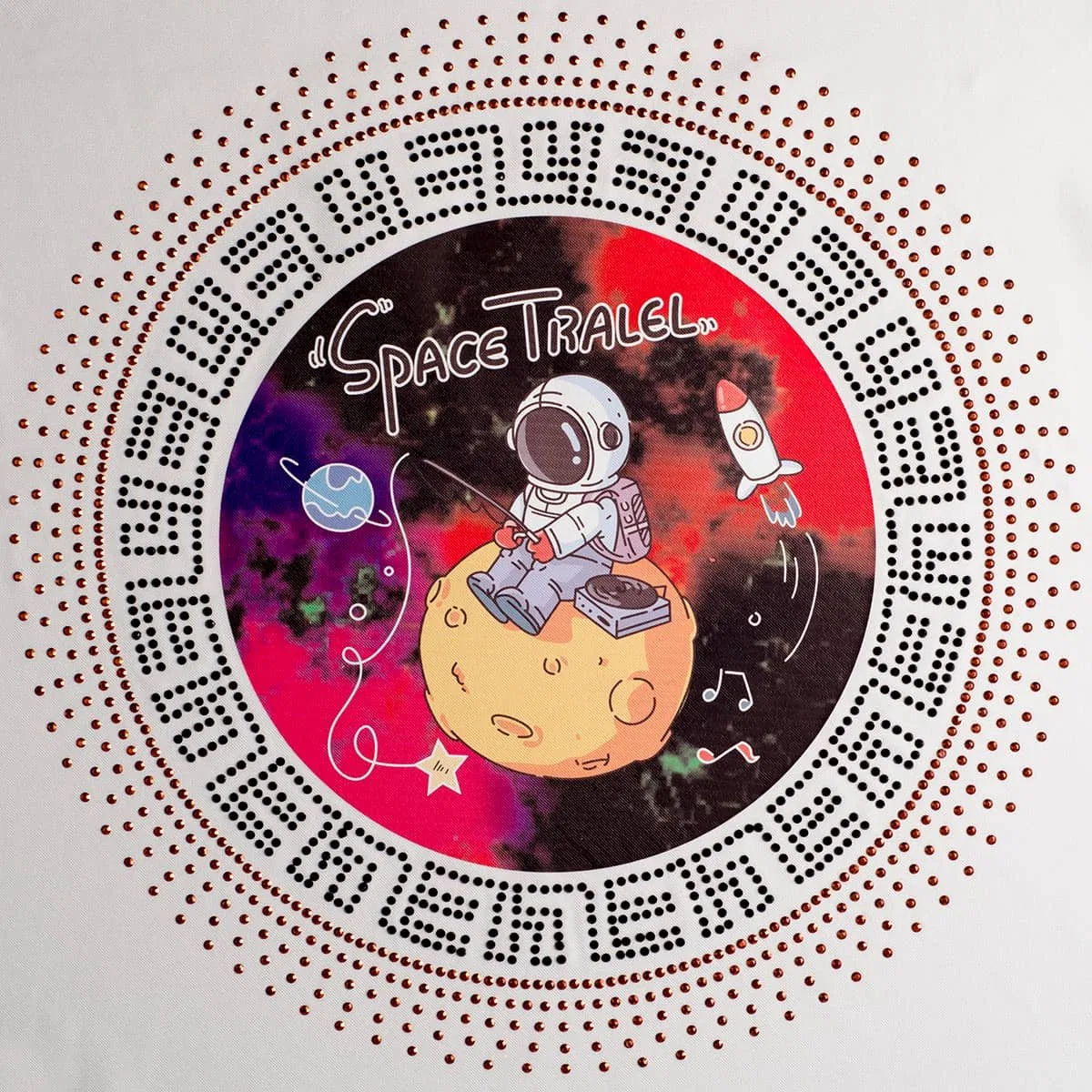
A separation brief should name the purpose of every visible area before production geometry is drawn. Print is suited to connected shapes, small tonal shifts and details that depend on uninterrupted color. Rhinestones work as discrete reflective coordinates, so they need enough room to remain individually legible. Negative space is a third layer: it keeps highlights from filling counters, facial features or narrow lettering.
List flat colors, gradients, halftone decisions, underbase assumptions and any line that must remain continuous. Supply the original editable artwork rather than a compressed screenshot.
Mark highlight paths, outline accents, focal symbols and allowed stone-size changes. A custom hotfix T-shirt design should identify the garment color because contrast alters the apparent balance.
Use separate layer names and a composite preview. That small discipline lets the buyer compare heat transfer designs for T-shirts without confusing artwork color with crystal placement.
Three active records illustrate different review stages. Product 30 is named Rhinestone and Printed Heat Transfer, with DMC rhinestone material, item code TB-5DDFA302FF3C and MOQ 50. Product 32 is an SS3 Skull Rhinestone and Printed Heat Transfer; its record lists rhinestone material, 28 × 28 cm, code TB-A7F95C8CE6A9 and the same minimum. Product 87 moves the discussion onto a customizable T-shirt blank.

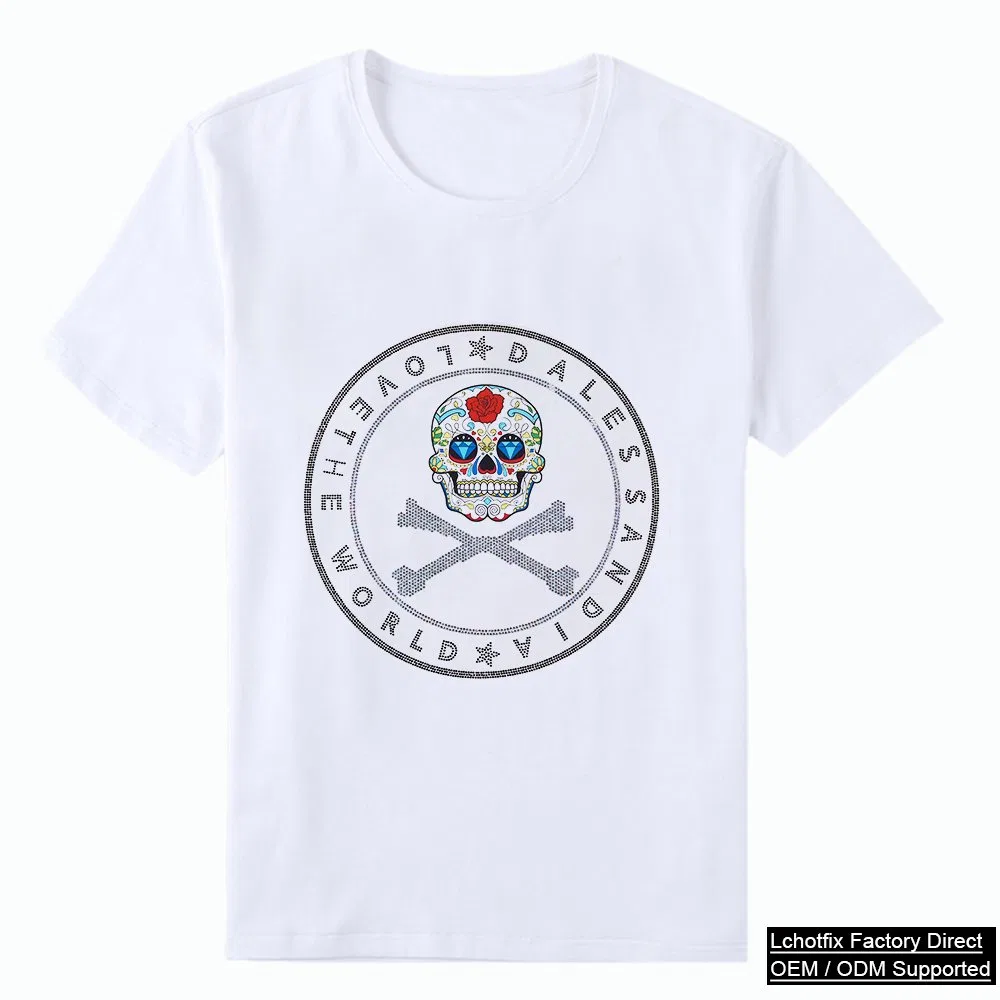
Open the Product 30 record, Product 32 record or Product 87 record when citing a reference. Photographs identify catalog direction; they do not prove current ink recipes, exact stone counts or application settings.
Print and stone layers must meet at a controlled origin. Add a finished-width dimension, centerline and visible registration relationship to the composite. Do not let one layer be scaled independently after approval. Where stones sit near a printed edge, specify whether the intended effect is overlap, a measured gap or deliberate crossing.
For file preparation details, use the rhinestone transfer artwork guide. The approval should retain both source layers plus the composite, so later corrections can be traced without rebuilding the separation from memory.
Fine print can close, while a dense stone map can merge into an unreadable block. Review the smallest printed line, narrowest gap, tightest stone turn and most important letter counter at the requested finished size. Then repeat the review on the smallest garment or placement zone in the order.
If multiple dimensions are needed, create named size groups and approve each composite. Product 30's recorded 30.4 × 30.4 cm and Product 32's 28 × 28 cm are catalog facts for those references, not universal recommendations for other artwork.
Buyers researching rhinestone shirt transfers should compare the measured artwork field rather than assuming the picture fills every shirt in the same proportion.
Printed color is usually judged as a filled area; rhinestones change as light and viewing angle move. A single screen preview cannot settle both. Name the ink targets, garment color, crystal color zones and any appearance that is critical to brand recognition. Photograph a coded sample under a repeatable setup, then retain the physical reference when reflective behavior matters.
Record the exact blank or substrate color used for the sample.
Approve connected color areas and their boundaries before stones are assessed.
Review hue, highlight pattern and spacing from intended viewing distances.
Check that neither layer hides the other or alters the intended focal order.
The rhinestone color selection guide provides a separate framework for crystal references. Avoid replacing a named physical approval with an informal color label.
Use the intended transfer construction, print layer, stone map, receiving garment and equipment in one documented trial. The purpose is to establish an order-specific result, not to publish an unsupported universal temperature, pressure or durability claim. Ask the supplier for the applicable instructions, then record the conditions actually used.
Identify blank, artwork revision, transfer code and operator.
Record equipment, supplier instructions and observable placement.
Check registration, print surface, missing stones and visible garment change.
Code the sample and store photographs with the approval decision.
Use the heat-press test guide to structure garment-specific evidence. Requests for iron on sparkle transfers should still identify the actual product construction rather than using “sparkle” as a technical specification.
The answers below keep catalog evidence, artwork decisions and physical testing in their proper roles.
Reserve print for gradients, fine illustration, tight color changes or information that would lose meaning in a spaced stone grid. Mark rhinestones only where individual reflective points support the intended hierarchy.
The database identifies Product 30 as Rhinestone and Printed Heat Transfer, records DMC rhinestone material, a 30.4 by 30.4 cm reference size, item code TB-5DDFA302FF3C and a 50-piece minimum.
Use a composite proof with named print and stone layers, shared origin marks and a measurable finished boundary. Then inspect a coded physical sample for offsets that are difficult to judge on screen.
No. A catalog image identifies a visual reference. Send color targets, final dimensions and authorized artwork, and request an item-specific proof or sample for the details that control acceptance.
Print, carrier, rhinestones and garment form one application system. A trial on the stated blank lets the buyer document alignment, visible surface response and the result produced by the intended equipment.
Package the authorized editable artwork, separate print and stone layers, composite preview, requested finished dimensions, garment identification, color references, quantity by version and required destination. Cite a catalog product only when it genuinely frames the request. Ask Teebling to confirm the proposed construction, proof route, sample scope, current terms and timing in writing.
Approval should identify the exact revision, code the physical trial and state what was accepted: layer assignment, registration, scale, colors, surface appearance and packing identity. That record prevents a later print correction from silently shifting the stone map.