


Match
Product code, artwork version, color and destination must agree.
Preserve mapped stones while a carrier is received, inspected, moved, placed and released. Each hand position and support decision should follow the current instruction for the actual transfer rather than an assumed rule borrowed from another sheet.

Match the package to the work order and approved artwork revision. Read orientation marks, supplier handling notes and any package sequence before opening. Inspect visible damage, count status and lifted edges without pressing on the transfer face.
Product code, artwork version, color and destination must agree.
Photograph package condition and visible sheet concerns.
Move unidentified or disturbed stock to a controlled hold.
Only approved carriers enter the handling sequence.
Rhinestone transfers for heat press arrive as production components, not loose decoration. Their map identity must survive every work-area handoff.
Product 28 is Adhesive Rhinestone Transfers for T-Shirts and Hats: DMC rhinestones, 20 × 18 cm, MOQ 50, code TB-B6638275B13E. Product 31 is Men's Hotfix Rhinestone T-Shirt Transfer: DMC rhinestones, 30.2 × 30.2 cm, MOQ 50, code TB-64B86AE2A1E1. Similar material wording does not prove identical carrier behavior.
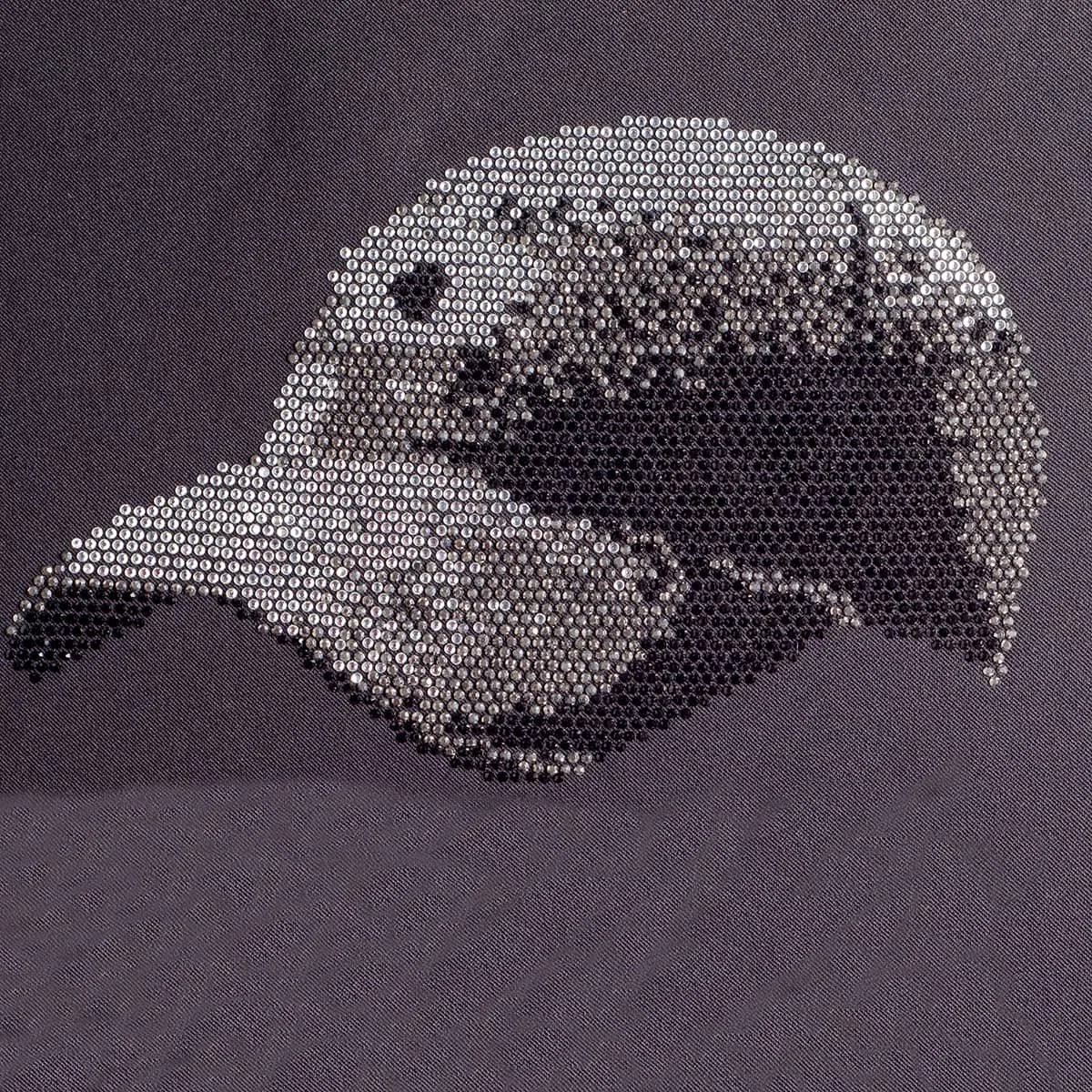

See Product 27, Product 28 and Product 31 for active catalog context.
Lay the supported sheet in the orientation permitted by its instruction and compare it with the approved map. Do not rub, slide or press stones into place as an informal correction. Mark concerns on a photograph or transparent review overlay rather than on the carrier itself.
Look for edge lifting, tears, folds and incomplete boundaries.
Compare high-coordinate areas for displacement or missing points.
Confirm top, face, mirrored status and garment relationship.
For a broader inspection record, use the rhinestone transfer quality checklist. Ready to press bling still needs an identified, inspected carrier before it is staged.
Some placement jobs may benefit from reducing excess carrier, while others should remain untouched. Ask whether cutting is allowed and request the safe margin for that transfer. Preserve registration marks, mapped stones, orientation labels and enough support for controlled handling.
Show the proposed path on a copy of the carrier image, identify the tool and name the operator authorized to trim.
Inspect the new perimeter, recount affected windows and update the handling record with photographs.
No universal trim distance is asserted here. Heat rhinestone transfers should be prepared according to their documented construction and receiving-surface plan.
A carrier can flex or shift between inspection and application. Establish a short, clean route and use support that holds the complete mapped field. Keep the face protected as directed, avoid stacking unrelated versions and hand the sheet directly to the named station.
Use the approved grip area without pinching the map.
Keep the carrier flat and orientation visible.
Avoid sliding, bending and unlogged intermediate storage.
Verify revision and garment job with the receiving operator.
The transfer sheet storage guide covers packages waiting beyond the immediate work sequence.
Handling ends only after the carrier has supported accurate placement and the application instruction has been completed. Keep garment and sheet identity visible throughout the station record.
Confirm exact blank, color, size and obstacle map.
Use documented centerlines and landmark measurements.
Lower the supported carrier without dragging the map.
Follow current instructions and record actual equipment conditions.
Use the instructed sequence; inspect the resulting garment.
Rhinestone heat press transfers require a garment trial because carrier handling alone cannot establish application behavior. Use the heat-press test guide for that separate approval.
These answers keep trimming, support, transport and release tied to the identified sheet and its current instruction.
No universal trimming instruction applies here. Confirm whether trimming is allowed for the specified carrier, then preserve the supplier-defined margin and orientation if a cut is approved.
Verify product and artwork identity, orientation, visible sheet condition, lifted areas, displaced stones and package instructions. Isolate uncertainty before the transfer reaches the garment station.
Use clean support sized for the complete sheet, avoid flexing or sliding, preserve orientation and log the handoff. The exact method should follow current supplier guidance for that construction.
No. Release behavior belongs to the product-specific application instruction and garment trial. Record what was used and what the operator observed on the approved sample.
Handling preserves the mapped sheet before application; the press trial evaluates the sheet, garment and equipment together. Separate records make the source of a displacement easier to investigate.
Send product and artwork identity, sheet dimensions, orientation, supplier instruction, inspection windows, allowed trim decision, support method, destination station and garment placement reference. Ask Teebling to confirm the applicable carrier and application information for the proposed item.
Operators comparing bling transfers should not reuse a station card merely because two sheets look similar. Archive the signed card with the coded garment trial and any recorded deviation.