


Key ring
Record the key bundle context, expected opening action, overall scale, and whether the decorative body must remain clear of keys.
Rhinestone keychain hardware turns a decorative motif into a complete hanging assembly. Record the intended use, ring, clasp, connector sequence, finish, movement, motif orientation, and packaging as one system. Catalog photographs can start the discussion, but only a written bill of materials and approved sample can close it.
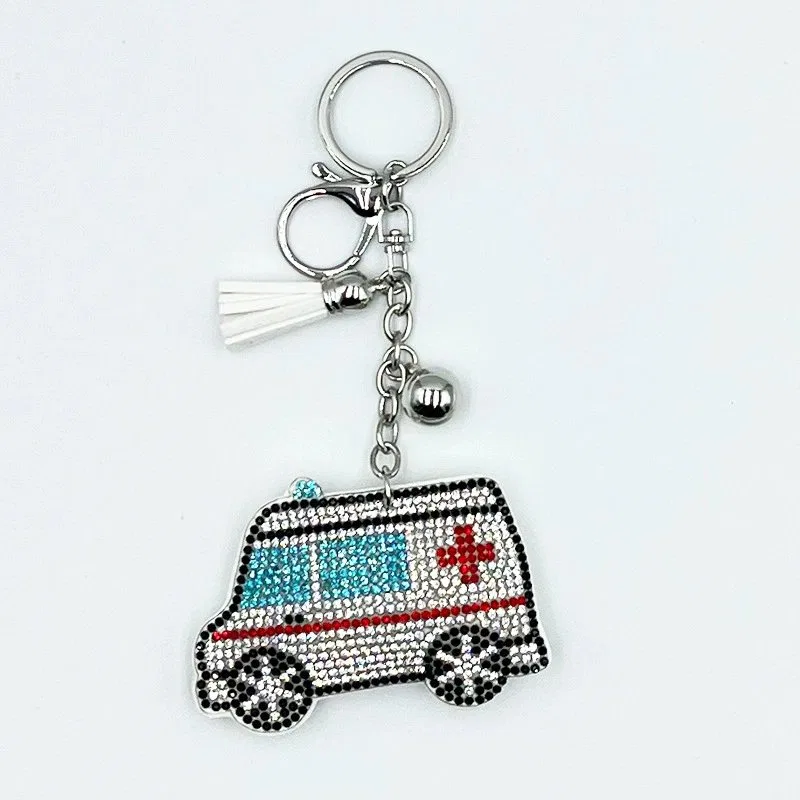
Start with the buyer’s use case rather than a hardware nickname. A key ring, zipper pull, bag handle, ID pouch, gift card, display hook, and medical bag charm can require different attachment access and hanging behavior. Measure the receiving loop or opening, describe how the user attaches and removes the piece, and state whether frequent transfer between items is expected.
Record the key bundle context, expected opening action, overall scale, and whether the decorative body must remain clear of keys.
Identify handle, zipper, D-ring, or loop geometry. “Bag charm” alone does not define the connector.
Specify presentation, card orientation, removal experience, barcode clearance, and whether hardware is visible in package.
For a medical or nurse theme, confirm that the item is decorative and do not imply clinical certification or safety performance.
The bag charm assortment guide addresses motif and tassel coordination across a line. This page owns component selection for each complete hanging unit.
Product 110 is Sparkling Ambulance Rhinestone Keychain, with Rhinestones, Metal, size 2.7 × 1.6 inches, item code HC-YWXK-016, and MOQ 50. Product 138 is Crystal Medical Kit Keychain, with Rhinestones, Metal, Fabric, 2.8 × 2.2 inches, HC-YWXK-044, and MOQ 50. Product 139 is Crystal Nurse Cap Keychain, with Crystal, Metal, Fabric, 2.6 × 1.5 inches, HC-YWXK-045, and MOQ 50.
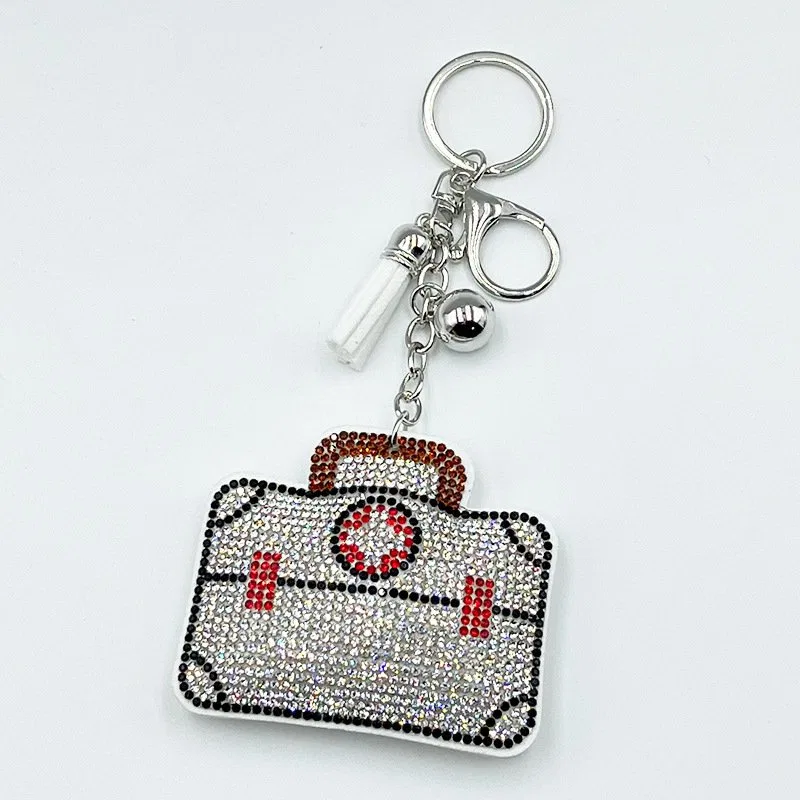
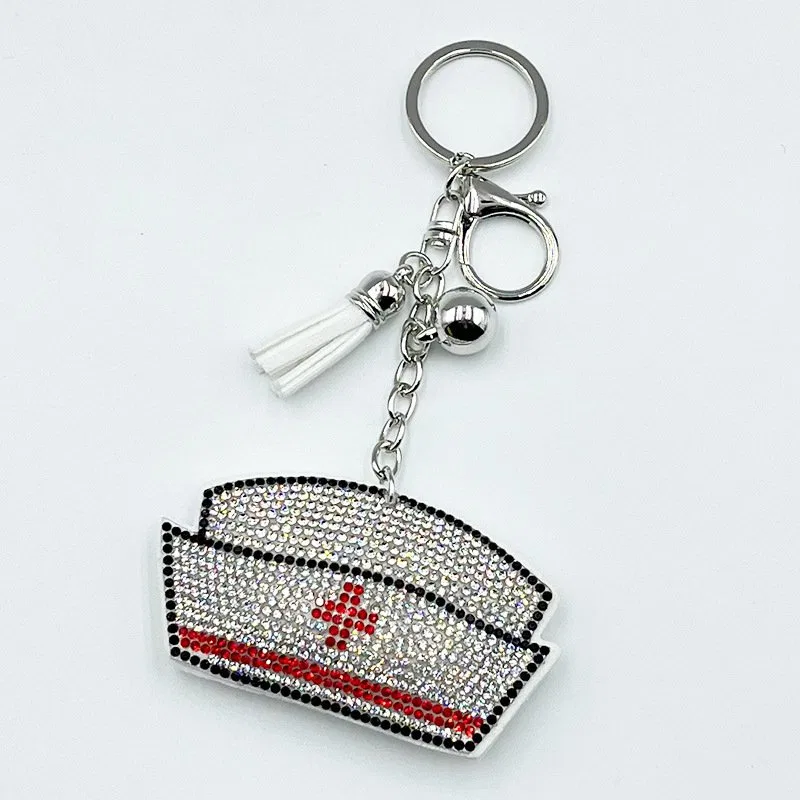
None of these rows records ring diameter, clasp style, jump-ring gauge, connector dimensions, metal composition, plating, finish, load, movement range, or component-level tolerances. Those fields must be confirmed for a rhinestone keychain wholesale order.
Create a simple exploded diagram rather than listing “standard hardware.” Number the primary attachment, secondary connector, chain or link, motif eye, decorative body, tassel or fabric element, and any stopper. Arrows should show assembly order and the direction the piece hangs. If the catalog reference uses a component that is not intended for the new order, cross it out visibly.
Primary ring or clip: proposed type, dimensions, opening action, and finish.
Connector: proposed jump ring, link, swivel, or other supplier-confirmed finding.
Decorative body: motif code, orientation, recorded materials, and overall dimensions.
Repeat the drawing for every hardware variant. A “gold option” and “silver option” may involve more than color; ask whether material, plating process, connector supply, or component dimensions also change. The bow keychain sourcing guide provides motif-focused context without replacing this assembly map.
Ask for an actual hardware sample or a dimensioned proposal and test the complete assembly on the intended object. Record internal clearance, external size, opening direction, user motion, interference with the motif, and how the piece rests after attachment. Do not infer ease of use or strength from the apparent thickness in a photograph.
What is the confirmed geometry and how will the user load the intended keys or loop? Does the decorative connector remain clear of the opening path?
What receiver can the opening accept, how is it operated, and does the mechanism face the correct direction when the motif hangs?
Is rotation part of the proposed assembly, and what visual orientation should the body return to during display?
Which joining parts are closed, how are they oriented, and how will the approved sample identify them for repeat orders?
No load rating or guaranteed cycle life is claimed here. If a buyer requires quantitative mechanical performance, the method, sample size, criteria, and responsible testing party must be specified independently.
Finish changes the visual relationship among metal, rhinestones or crystal, fabric, and tassel. Supply a named reference or approved previous component, but judge the proposed hardware physically beside the motif. Record color family, surface appearance, and intentional contrast without promising exact equivalence between screen color, stone reflection, fabric, and plated metal.
State whether a physical chip, retained item, supplier swatch, or digital target controls the inquiry and which one becomes the approval authority.
Ask whether all metal-visible parts share the same proposed finish. List exceptions rather than assuming the primary ring controls every connector.
Define any required test or appearance rule with the buyer. This page makes no corrosion, plating thickness, nickel, colorfastness, or durability claim.
Approve each finish on a complete sample under agreed viewing conditions. Keep the finish sample code in the bill of materials so wholesale rhinestone keychains are not reordered from a verbal description such as “same gold.”
Hang the sample from the actual key bundle, zipper, bag loop, or display card. Observe whether the motif faces forward, tangles with the connector, strikes adjacent parts, hides behind a tassel, or turns the package off balance. These are project observations, not guaranteed performance. Record the receiving object and orientation so another reviewer can reproduce the setup.
Photograph front, side, and resting orientation with a scale and the sample code visible.
Watch the intended opening action and note where fingers, keys, bag hardware, or fabric compete for space.
Check how the motif and findings sit in the proposed package without asserting a drop or vibration standard.
Confirm card hole, hook, barcode, warning, and artwork clearance before packaging is printed.
For travel motifs, the globe travel keychain guide shows how a theme can be ranged while retaining product-specific specifications.
A photograph cannot support repeat purchasing when several rings and connectors look similar. Give each finding an internal code and retain the supplier-confirmed description, dimensions, finish, position, quantity per assembly, approved sample, and revision. Connect the decorative body to its exact recorded product facts and treat alternative hardware as a separate SKU or approved substitution.
| Line | Component | Control fields | Status |
|---|---|---|---|
| H1 | Primary attachment | Type, dimensions, opening, finish, source | Supplier confirm |
| H2 | Connector sequence | Part identities, count, orientation, closure | Supplier confirm |
| D1 | Decorative body | Product/custom code, material, size, motif | Buyer verify |
| P1 | Presentation | Card, bag, label, orientation, quantity | Quote confirm |
Products 110, 138, and 139 each record MOQ 50, but a current quote must confirm assortment allocation, pricing, packaging, sampling, timing, and delivery. A catalog MOQ does not prove that three motifs can share one minimum.
These answers distinguish catalog assembly evidence from unrecorded hardware specifications and buyer-defined performance requirements.
The row records Rhinestones, Metal, 2.7 by 1.6 inches, item code HC-YWXK-016, and MOQ 50. It does not record ring diameter, clasp type, connector dimensions, plating, finish, or load rating.
No. Use it to identify a reference assembly, then request written component identities, dimensions, finish samples, connector sequence, and an approved complete physical unit.
It can be a merchandising or intended-use description, but Products 110, 138, and 139 are stored as keychains. Confirm how the buyer expects the assembly to attach before specifying hardware.
A screen image can guide the inquiry but cannot confirm a physical finish. Ask for the supplier proposal and approve a labeled sample under agreed viewing conditions.
List motif, stone or decorative body, ring, clasp, jump ring or connector, chain, tassel or fabric element if present, finish, dimensions, orientation, packaging, sample code, and revision.
For a bling keychains wholesale inquiry, send motif references, intended attachment object, complete hardware map, finish target, dimensions, orientation, quantity by variant, packaging concept, and sample approval owner. Ask Teebling for written confirmation of every proposed finding.
Release the motif, ring, clasp, connector chain, finish, dimensions, orientation, packaging, quantity split, and accepted physical sample as one revision-controlled specification. Keep every unapproved alternative outside the production bill.
This gives rhinestone keychain hardware enough definition for sourcing without inventing component dimensions, metal grades, plating, load, safety, price, or delivery claims.