


Upper wings
These broad fields establish most of the visual span. Review stone rhythm, outer curves and the balance between left and right.
Choose a butterfly component by its complete physical form: wing span, height, center body, textile support, profile, placement and confirmed attachment. Three active Teebling references provide factual scale points for a compact patch, a floral-butterfly accessory and a large three-dimensional applique.
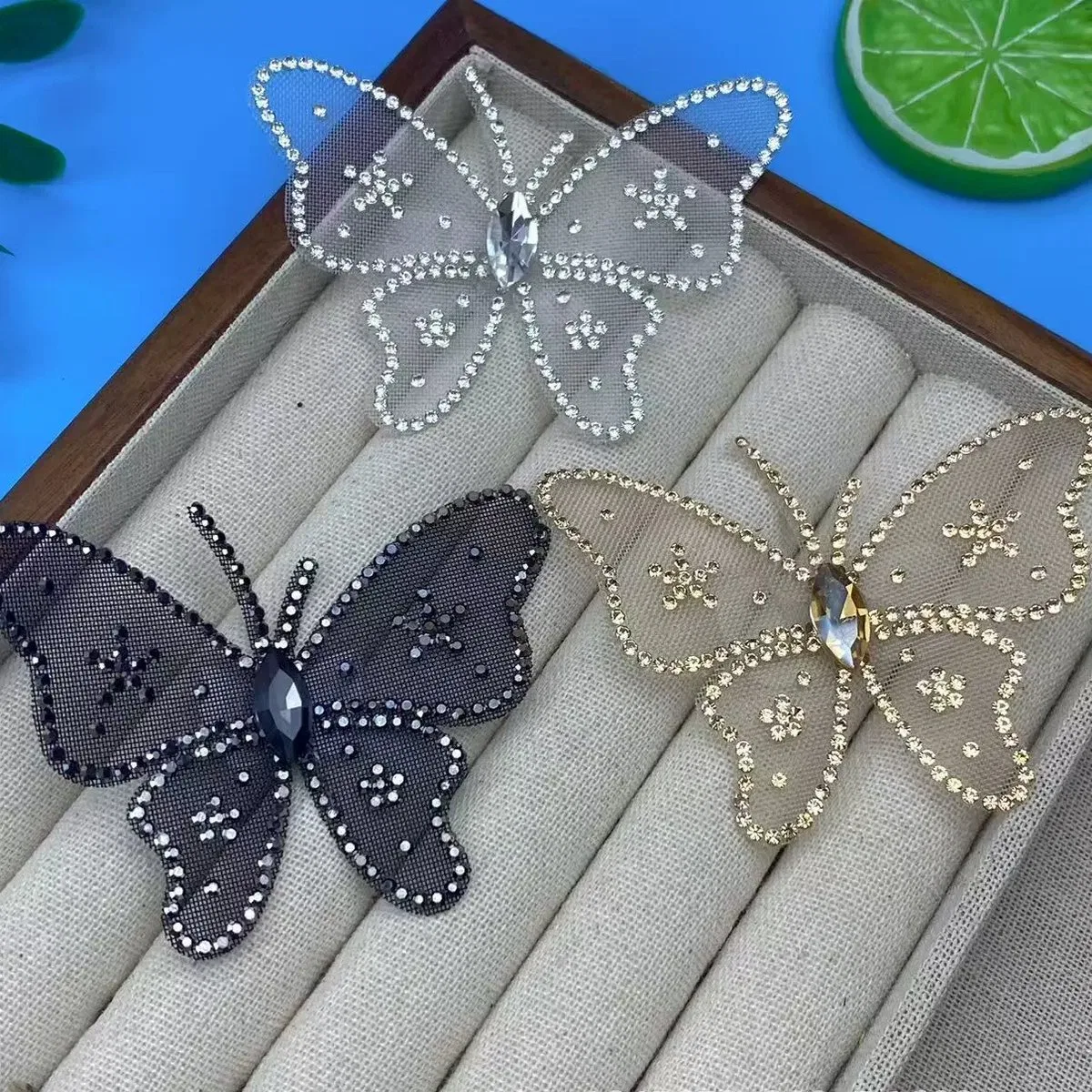
A butterfly silhouette can look complete from a distance while containing very different production challenges around its points, curves and center. Label the parts on the chosen sample so artwork review, inspection and placement use the same vocabulary.
These broad fields establish most of the visual span. Review stone rhythm, outer curves and the balance between left and right.
Smaller lobes or tails affect the bottom outline. Check narrowing edges and how they contact the receiving surface.
The central axis controls orientation and can separate raised wings. Confirm its width, straightness and relationship to the complete motif.
Observe felt or mesh visibility, outside contour and the reverse. The visible face alone does not confirm attachment.
For custom work, provide an authorized vector silhouette with clear left-right geometry and finished dimensions. If asymmetry is intentional, label it on the proof so it is not corrected by assumption.
The active database records different dimensions and names for Products 56, 83 and 84. Use those facts to compare scale and direction, but request current color, backing, price and option details for the item selected.
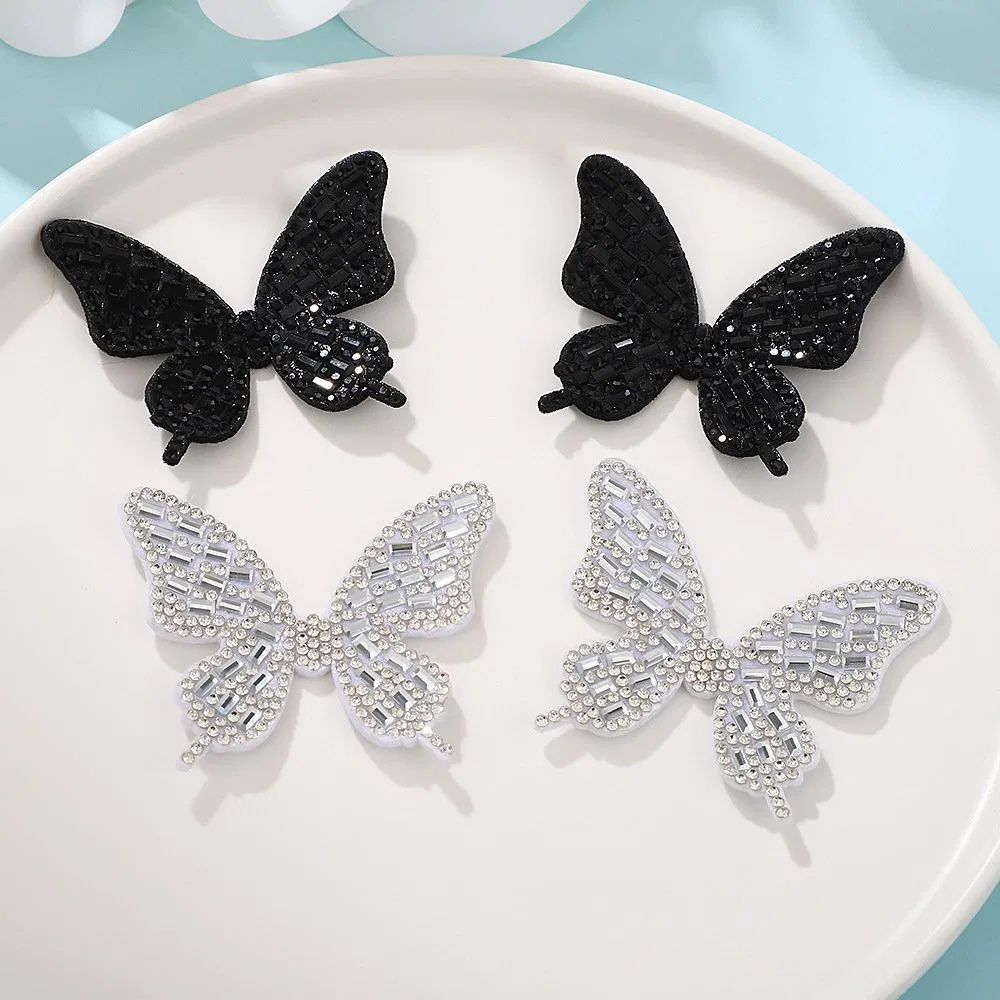
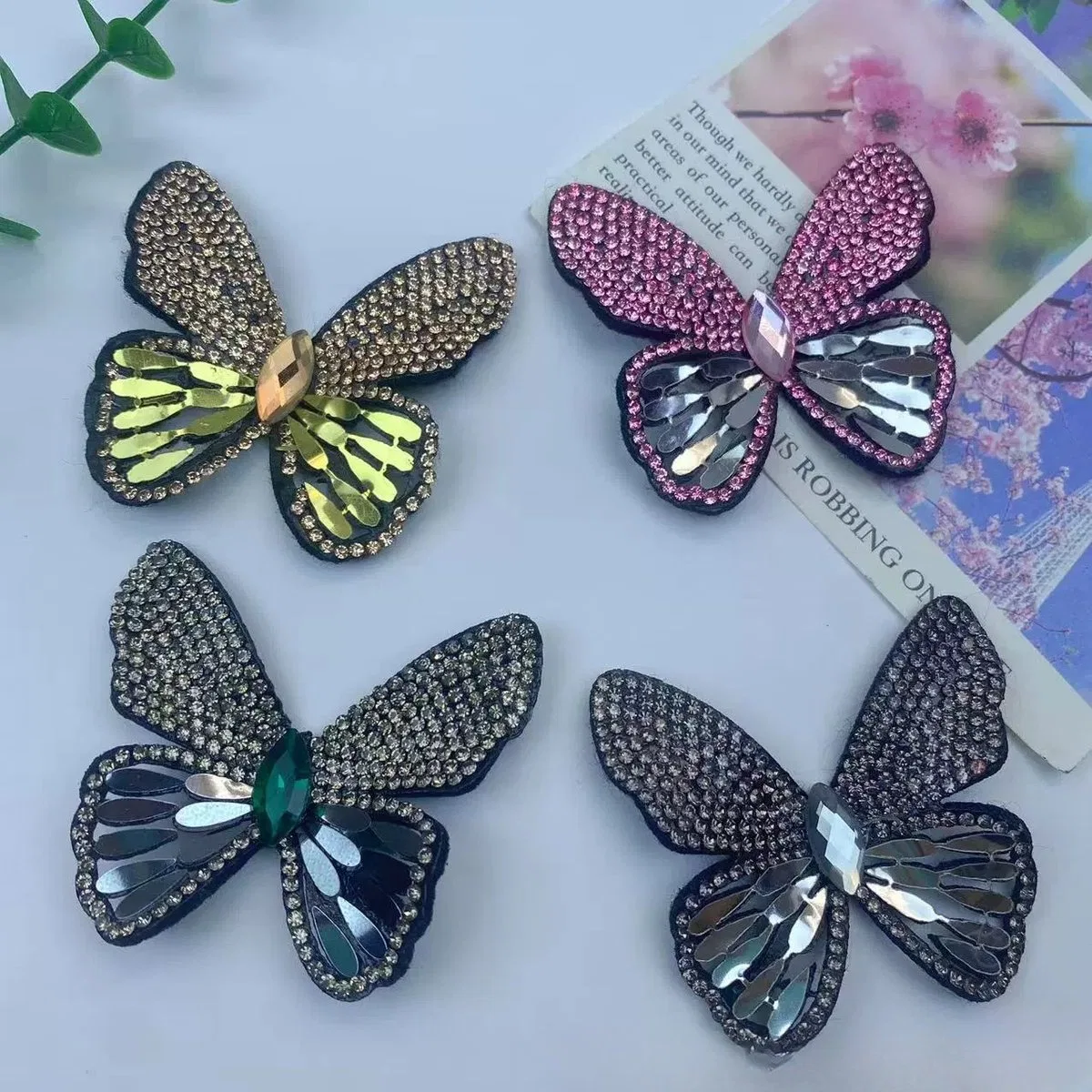
Product 56 carries iron-on in its name, while Product 84 carries 3D and mesh in its name. Product 83 combines flower and butterfly language. Preserve those distinctions in title, alt text, quotation and purchase line.
Screen tiles conceal the difference between a 5 cm patch and a 13 cm applique. Draw each full bounding box at one-to-one scale and set it on the intended garment, shoe, bag or accessory. Include seams, hardware and edges in the placement decision.
Product 56 can be considered for a smaller decoration zone, subject to attachment and substrate review.
Product 83 uses a different footprint and includes a flower-and-butterfly direction in the title.
Product 84 occupies a much larger field. Confirm edge clearance, profile and packing before committing to placement.
Dimensions belong to the shown catalog entries. A custom resize can change stone spacing, textile visibility and outline behavior, so it requires a new proof rather than a percentage instruction.
When a product is described as 3D, the buyer should evaluate how the wings stand, curve or layer in the physical sample. Record the resting profile, center-body connection, edge stability and how the applique behaves when positioned on the intended surface.
A flatter iron-on patch has a different review. Inspect contact across the face, especially around wing tips and curved edges. Do not assume that an attachment process or packing method suited to one profile applies to the other.
Mark the receiving surface as the baseline. Add the highest visible point, outside edges and any area that does not lie flat. Photograph the sample beside a scale reference and identify its product code.
The decorative component and the end product form one system. Identify surface material, movement, curvature and access, then request an applicable attachment direction for the exact product.
Place the center axis deliberately, avoid bulky seams and evaluate the motif on the smallest and largest ordered garment sizes.
Check curvature, movement and press or sewing access. A wide wing span may wrap or cross construction lines.
Map lining, pockets, coating, padding and hardware. Confirm whether the working surface can be supported during assembly.
Footwear materials and shapes vary considerably. Do not infer heat compatibility from the word iron-on; request a surface-specific review.
If the item is sold as a craft component, define individual presentation, instructions and protection without promising compatibility with every customer surface.
The rhinestone patch buyer guide, custom iron-on patch guide and rhinestone felt patch guide provide related construction questions.
Large or profiled motifs may need different protection from compact flat patches. Define the packing around the actual sample, not around a generic piece count. The buyer's receiving team should be able to identify, count and inspect each variant without unfolding a mixed pile.
Specify whether decorated faces require interleaving, sleeves or another reviewed separator. Prevent neighboring hardware or stones from rubbing the approved surface.
For a raised applique, ask how the wing form will be protected from compression. Inspect a packed sample before accepting the bulk method.
Print product code, color or version, quantity and orientation on each inner pack. Reconcile the labels with the purchase ledger.
Group designs deliberately, state carton counts and identify the destination. Photograph the approved arrangement for future reorders.
These answers hold the line between recorded size and custom options, clarify the word applique and keep attachment claims tied to the selected product.
Product 56 records 6 by 5 cm, Product 83 records 5.7 by 5.7 cm, and Product 84 records 13 by 9 cm. Each active listing records a minimum order of 100 pieces.
No. It describes a decorative component, not a complete reverse specification. Ask Teebling to confirm the backing or assembly options for the exact quoted product and intended receiving surface.
Review complete width and height, wing profile, center body, edge construction, surface contact, placement and packing. Approve a physical sample because one front photograph cannot show the full profile.
Those surfaces vary in heat tolerance, texture, curvature and access. Identify the exact product and requested zone, then ask for a compatible attachment proposal and test the selected pairing before bulk use.
Define orientation, separation, inner-pack count and support needed to prevent compression or tangling. Confirm the final packing method in the quotation and inspect it with the approved sample.
Cite Product 56, 83 or 84; add the exact receiving product, measured placement zone, requested attachment, quantity per version, individual packing, carton grouping, destination and required date. If you need a custom butterfly, attach authorized editable artwork and a one-to-one size drawing.
Ask Teebling to confirm current construction, backing, options, price and timing for the selected item. Keep the identified physical sample, application evidence and packed presentation with the final record so the next order is based on evidence rather than a similar butterfly image.