


Artwork
Attach a legible production file and identify every version that requires its own setup.
A useful quote is a priced version of one defined job. Build the request around artwork, construction, measured size, variant allocation, sampling, packing and destination so the supplier can cost what the buyer actually intends to receive.

“Transfer,” “iron-on” and “bling” describe broad buying territories rather than complete manufacturing instructions. Begin with the authorized artwork revision and name the intended construction: for example, a rhinestone layout, a combined printed and rhinestone composition, or a laser-cut fabric component carrying rhinestones. Add the destination product and the required reading orientation.
Attach a legible production file and identify every version that requires its own setup.
State the expected component family without substituting an unverified catalog assumption.
Give finished width and height in one unit and distinguish the art field from its carrier.
Break total quantity into designs, colors, sizes or destinations that must remain separate.
Describe grouping, identification and carton information needed at receipt.
Provide the city, country, timing objective and commercial basis requested for freight.
Wholesale heat transfer pricing factors become comparable only when competing requests use the same revision and scope. A buyer seeking wholesale order custom iron ons should also record which decisions remain open, because alternatives cannot be priced as though they were approvals.
Three current records show why a product name cannot stand in for a quote specification. Product 30 is Rhinestone and Printed Heat Transfer, with material recorded as Rhinestone DMC, a 30.4 × 30.4 cm size, MOQ 50 and code TB-5DDFA302FF3C. Product 168 is Laser Cut Fabric Rhinestone Heat Transfer Patch, recorded as fabric, rhinestones and holographic crystal with MOQ 50 and code RJX-501.
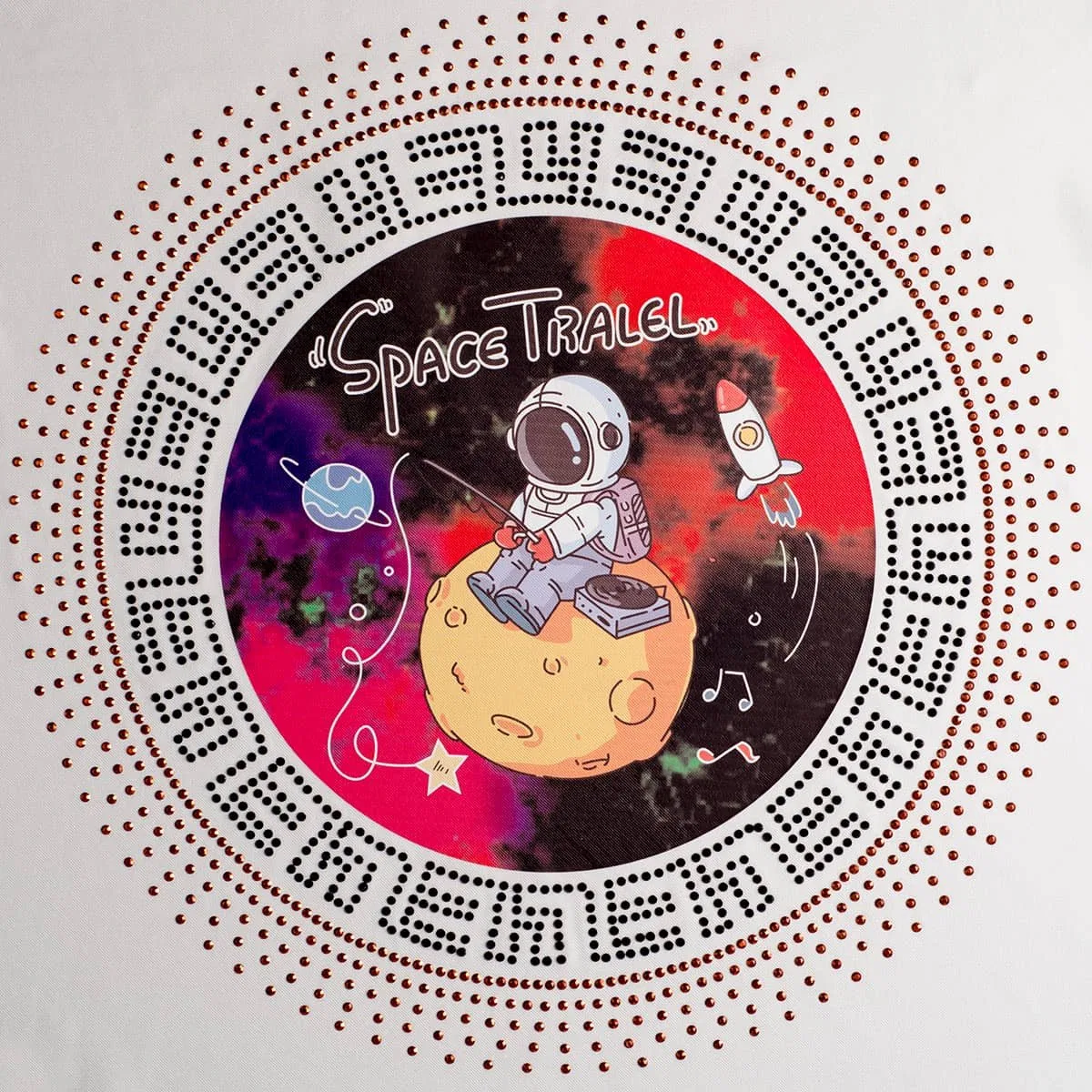
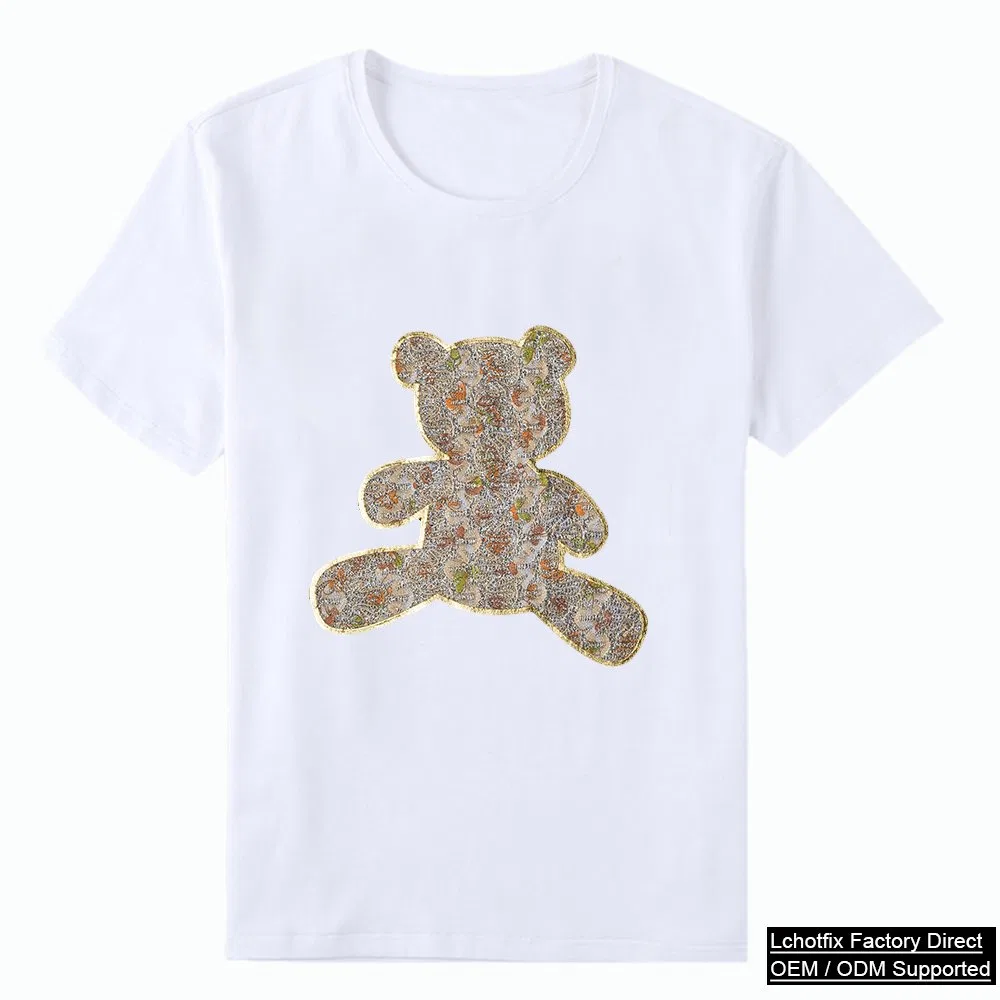
Compare Product 26, Product 30 and Product 168 as distinct catalog identities. Their shared MOQ record does not prove identical labor, material usage or quotation terms.
Two transfers can share an outside rectangle yet contain very different production work. A quotation review may need the occupied decoration area, element count, stone sizes and colors, printed regions, laser-cut contours, openings, fine bridges, registration relationships and carrier layout. Supply vector paths or another supplier-approved production source instead of asking a thumbnail to carry those details.
Rhinestone heat transfers wholesale should be quoted from the released layout rather than a verbal estimate of “simple” or “detailed.” The rhinestone artwork file guide explains how to package production evidence without inventing missing specifications.
State the finished decoration width and height, measurement unit and permitted tolerance request. Then identify whether the dimension describes the decorated design, a fabric base, a cut component or the full transfer carrier. These areas are not interchangeable. Include a true-size proof with a scale bar and do not derive a new design size from a photograph.
Mark the outermost applied element and provide the occupied regions inside that boundary. This lets a reviewer distinguish a sparse layout from a densely filled one.
For mixed constructions, dimension the fabric, print, stone and cut edges independently wherever their outlines differ.
Request the necessary handling clearance and packing orientation from the supplier instead of assuming it equals artwork size.
Product 26’s 30 × 21 cm record, Product 30’s 30.4 × 30.4 cm record and Product 168’s 8 × 10 inch design-area fields belong only to those database entries. None of them is a default dimension for a new design or evidence of a universal price tier.
A total order of 1,000 does not explain whether the factory sees one repeated design or twenty small versions. List quantities by artwork, colorway, component option, destination group and packing identity. Ask how the supplier treats each split and whether a recorded MOQ applies per order, design or variant; this guide does not assign that rule.
The unchanged production layout tied to one version code.
A deliberate substitution of stones, print, fabric or another visible component.
Units separated for different facilities, labels, languages or carton marks.
A later run that must cite the approved sample and any storage or setup assumption.
The database records MOQ 50 for Products 26, 30 and 168, but that shared number alone does not establish one pricing equation. Use the MOQ allocation guide to present a clean variant matrix before requesting bling transfers wholesale.
Tell the supplier whether the request needs an artwork review, physical sample, duplicate retain, application trial or pre-production approval. Identify who supplies the receiving garment, how many sample pieces are required, where they travel and which evaluation controls release. Sampling is a separate scope question; the catalog records cited here do not state a universal sample charge or timetable.
Confirm files, fonts, scale, component notes and buyer authority before development begins.
Approve dimensions, layout and named colors without treating a screen display as a material standard.
Identify the exact construction and receiving surface represented by the physical piece.
Use current product-specific application instructions and record the actual equipment context.
Accept, revise or reject against written criteria while retaining the decision record.
Freeze the approved revision and prohibit silent substitutions during production.
A buyer should ask which development items are included, separately charged, credited or excluded in the written offer. The custom T-shirt transfer order guide connects those approvals to the wider purchase packet.
Define how transfers must be grouped, counted, protected and identified before asking for a landed or shipment-based comparison. State inner-pack quantity, separation between designs, label data, carton marks, documentation needs and receiving destination. If a buyer provides no packing specification, quotations may silently assume different deliverables.
Ask the supplier to propose handling protection suited to the selected construction and expected transit, then approve it in writing.
Give each design and variant a short code that appears consistently on the proof, pack label, carton and purchase order.
Request currency, trade term, named place, freight inclusion, duty treatment and offer validity in explicit commercial language.
The bulk transfer packing guide helps turn receiving needs into checkable instructions. Do not compare one ex-factory unit number with another offer that includes special packing, split shipment or transport unless the differences are normalized.
These answers distinguish recorded catalog evidence from the variables that still require a dated project quotation.
Provide the approved artwork, finished dimensions, decoration construction, color and component details, destination garment, quantities by design, sample requirement, packing request, delivery destination and target schedule. A comparable quote also needs the same scope and commercial basis from every supplier.
No. The three catalog references on this page each record MOQ 50, but an MOQ is a quantity threshold rather than a complete quotation. New artwork, specifications, variants and delivery requirements still require a current written offer.
Their occupied decoration area, stone count, component mix, cutting path, carrier arrangement, color separations, setup work and inspection burden may differ. Send production-ready artwork so those differences can be reviewed instead of inferred from a bounding box.
Compare the complete commercial scope: unit basis, setup or sample items, included packing, quantity and variant assumptions, freight basis, currency, payment terms, validity period and exclusions. A lower isolated unit figure may describe a different deliverable.
No. It is a request-building framework, not a price list or promise. Ask Teebling for a dated, project-specific quotation and confirm every specification before authorizing a sample or production order.
Copy each supplier response into one comparison sheet without erasing its qualifications. Confirm product construction, artwork revision, dimensions, tolerance request, quantity allocation, sample scope, packing, currency, commercial term, destination, schedule basis, payment terms, validity and exclusions. Mark every blank as an open question rather than assuming it matches another offer.
Send this completed ledger to Teebling with the production files. Wholesale T-shirt transfers should move to sample approval only after the commercial scope and technical record describe the same job; any later artwork, allocation, packing or destination change needs a revised review.